Samsung Wallet (Samsung Pay)
- 4.1
- Rating
- 100.00M
- Installs
- Free
- Price

 Analysis by App-foxy
Samsung Wallet is the kind of lifestyle app that can quietly become useful every day, especially if you already use a Samsung phone. I tested it as a place for keeping payment cards and other essentials together, and my overall impression is practical rather than flashy: it works best when you prepare it once, make the right choices in settings, and then rely on a repeatable routine instead of opening it randomly whenever you need something. Its real strength is reducing small moments of friction, not replacing every wallet-related service in your life.
Developed by Samsung Electronics Co., Ltd., this free app is available for Everyone and runs on devices using Android 7.0 or later. It has been around since October 17, 2015, and its current version is 2.5.76. The scale of its audience is also clear: it has passed 100 million installs, with an average rating of 4.1 from around 1.1 million ratings and about 205 thousand written reviews. Those figures suggest a well-established product, although they do not mean the experience will be identical on every Samsung device or in every location.
How Samsung Wallet fits into a normal day
The basic workflow is straightforward. I open Samsung Wallet, add the essentials I actually use, and treat the app as a quick-access drawer rather than a complete replacement for my physical wallet. The important distinction is that the app is most valuable when it holds the items I reach for repeatedly. Loading it with every possible card or document can make the experience feel more cluttered, so I prefer a smaller, deliberate collection.
You May Also Like

 AccuWeather: Weather Radar
AccuWeather Review: A Quick, Clear Forecast for Everyday Decisions
For everyday plans, the best forecast is the one you can understand quickly. AccuWeather makes rain timing, radar, and local conditions easy to act on, with a few trade-offs.

 Hill Climb Racing
Why Hill Climb Racing Still Turns Crashes Into One More Run
A tiny car, a bumpy hill and one more upgrade: Hill Climb Racing keeps resurfacing because its simple chaos makes every near-miss feel personal.

 AliExpress - Shopping App
AliExpress Makes Global Shopping Feel Personal, but Shoppers Bear the Risk
AliExpress turns a global marketplace into a pocket-sized discovery engine. Its reach is useful, its shopping loop compelling, and its trade-offs easy to miss.

 Lords Mobile: Kingdom Wars
Lords Mobile Is a Kingdom-Building Routine, Not a Quick Match
A case-by-case verdict on the building, battles, device demands, and social commitments that make Lords Mobile rewarding for some players and exhausting for others.

 PDF Scanner app - TapScanner
TapScanner Makes Paperwork Easier to Capture, Check, and Share
TapScanner makes scanning with a phone feel less like a rescue operation and more like a dependable step in getting work done. Its capture tools are useful, though not flawless.

 Block Blast!
 Shows How Much a Puzzle Game Can Leave Out
A quiet grid game shows why puzzle players increasingly value instant clarity, repeatable skill and low-pressure play—and where the genre still needs to catch up.
More From Our News Desk
View All News


For a typical purchase, the useful habit is to prepare before reaching the checkout rather than start exploring the app while other people are waiting. I keep the phone unlocked or ready in the way I normally use it, bring up the wallet, select the intended payment option, and follow the on-screen confirmation process. That sequence becomes much less awkward after a few uses. The first session is about setup; later sessions are about consistency.
This is where Samsung Wallet differs from simply keeping card details in a notes app or relying on a physical card. A notes app may be easier for storing information, but it is not designed around a payment action. A physical wallet works without a battery, while this app depends on the phone and its normal security steps. I see Wallet as a convenience layer, not as a reason to stop carrying any backup at all.
A realistic example is a quick grocery stop after work. I do not want to search through a crowded pocket, pull out several cards, and put everything away while standing at the register. If my preferred payment method is already selected and the phone is ready, the transaction feels cleaner. The benefit is modest, but repeated small savings in attention are exactly why this kind of app earns a place on a home screen.
Samsung Wallet is also useful for people who move between several daily contexts. I might use one payment method for routine shopping, another for a personal expense, and a stored item for a separate task. The app gives those essentials a common location, which is easier to remember than scattering them among unrelated apps. That organization is more valuable than the brand name itself.
What to prepare before relying on it
My first recommendation is to add only the cards and essentials that have a clear purpose. Start with the item you use most often, complete the setup carefully, and perform a small test before depending on the app during a rushed purchase. This catches avoidable problems early, such as selecting the wrong card or discovering that your preferred routine requires an extra confirmation step.
I also keep a simple fallback. A phone can be out of power, unavailable, or inconvenient to use, and a digital wallet does not remove those ordinary risks. That does not make Samsung Wallet unreliable; it simply makes it sensible to retain another way to pay when the situation matters. For travel, long days away from a charger, or places where you are unsure what will work, this backup habit is more important than any shortcut.
Another useful preparation step is learning which item appears first and how to change the selection. Experienced use is less about adding more content and more about knowing exactly what will happen after the app opens. If the first card is not the one I use most, I change my routine or selection before I am standing at a counter. That small bit of planning prevents the most common kind of wallet-app hesitation.
Settings that deserve attention
The settings are worth reviewing because convenience and control are always in tension. A fast launch method can make payment feel immediate, but a more deliberate opening process may suit someone who shares a phone, worries about accidental actions, or simply prefers to see what is happening before presenting a card. I would not copy another person’s configuration automatically; I would choose the quickest method that still feels comfortable and understandable.
Security confirmation is another area where personal preference matters. The extra step can feel inconvenient when a queue is moving, yet it is also part of keeping access to payment tools from being completely casual. I would rather spend a moment confirming an action than make the app so permissive that anyone holding my unlocked phone could use it without friction. The right balance depends on how you normally protect the device itself.
It is also sensible to review notifications and permissions during setup rather than accept every prompt without reading. I want alerts that help me recognize activity, but I do not want unnecessary noise turning the wallet into another source of interruptions. The goal is a quiet, predictable tool: visible when I need it and unobtrusive when I do not.
Because this is a Samsung product, the smoothest experience is naturally tied to using it on a compatible Samsung phone. If your main device is from another manufacturer, or if you regularly move between different platforms, the appeal may be lower. In that situation, a wallet designed around the ecosystem you already use could be less confusing. Samsung Wallet makes the most sense when it fits the phone habits you already have instead of forcing you to maintain a separate routine.
Shortcuts and repeatable patterns
The biggest improvement I noticed came from treating access as a habit. Rather than searching through the app list every time, I use the quickest available route that I can remember reliably. The exact best route depends on the phone and personal setup, so the important principle is not a particular gesture; it is choosing one method and practicing it until it becomes automatic.
I also group my decisions before I arrive at the point of payment. If I know which card or essential I need, I do not browse through the whole wallet at the counter. I open it with a purpose, check the selected item, and continue. This sounds obvious, but it is the difference between a wallet that feels like a shortcut and one that feels like another menu to navigate.
A second pattern is keeping the most frequently used item easy to identify. Clear organization matters more than a large collection. If two cards look similar, I take an extra moment during setup to learn their order and appearance. That reduces the chance of selecting the wrong one when the screen is bright, the environment is noisy, or I am trying to move quickly.
For recurring errands, I use the same sequence every time: decide the payment method before checkout, open Wallet through the familiar shortcut, confirm the selected item, and put the phone away immediately afterward. Repetition turns a multi-step digital process into muscle memory. The best shortcut is the one you can perform without thinking about the app’s layout.
There is also a useful mental boundary: Samsung Wallet should handle the transaction or essential I opened it for, then I should leave. Browsing around while waiting can lead to accidental taps, unnecessary changes, or simply wasted time. I find it more dependable when I treat it like a tool with a beginning and an end, not a place to linger.
Where the convenience has limits
The most important limitation is dependence on the phone. Battery life, device access, and the condition of the handset all matter. A physical wallet is slower in some situations but does not ask whether the phone is charged or ready. I would not advise anyone to discard every backup simply because Samsung Wallet is convenient on ordinary days.
Compatibility can also shape the experience. The app supports Android 7.0 and later, but the operating-system requirement alone does not guarantee that every function will feel the same on every device. Samsung’s hardware, software configuration, and the services available where you live can influence what is practical. That is why I recommend testing the exact workflow you intend to use instead of assuming that another user’s setup will transfer perfectly.
There is a learning curve, even though the app itself is not difficult. New users may wonder which card is selected, when confirmation is required, or how to reach the wallet quickly. These are not serious flaws, but they are small points of friction that become noticeable when someone installs the app just before going out. Setting it up calmly at home is a much better experience than learning it during a busy purchase.
I also would not choose Samsung Wallet purely for the promise of having everything in one place. Consolidation is useful, but it can create a single point of dependence. If your priority is maximum platform flexibility, a service that follows you more naturally across different phone brands may be a better fit. If your priority is a Samsung-centered routine, that trade-off is easier to accept.
Privacy and security deserve practical attention rather than vague reassurance. A wallet contains sensitive essentials, so I use a strong device lock, keep the phone’s software maintained, and avoid handing an unlocked phone to someone else. The app can provide a convenient access point, but no wallet app can compensate for careless device habits. The safest setup is the one supported by good everyday behavior.
Who should use it, and who should skip it
I recommend Samsung Wallet to Samsung phone owners who regularly make contactless or digital payments and want a dedicated place for their most-used essentials. It is especially suitable for people who dislike carrying several cards, appreciate a quick phone-based routine, and are willing to spend a few minutes arranging the app properly. The large install base and long availability also make it feel like a mature choice rather than an experimental one.
It is less compelling for someone who rarely uses digital payments, prefers a physical wallet, or changes phones and platforms often. It may also frustrate users who expect every wallet function to behave identically regardless of device or location. For those people, the usual physical card, a platform-neutral alternative, or the wallet already built into their preferred ecosystem may be simpler.
Families and shared-device users should think carefully before treating it as a communal storage space. A wallet is personal by nature, and the convenience of quick access is not the same as convenience for multiple people. I would keep the setup focused on the primary user and avoid adding items merely because they belong to someone else in the household.
My verdict after making it part of a routine
Samsung Wallet succeeds when I use it with intention. Its free price removes the main barrier to trying it, and its Everyone content rating makes it approachable for a broad audience. Still, the best experience does not come from installing it and forgetting about setup. It comes from selecting the right essentials, checking access and confirmation preferences, learning a dependable shortcut, and keeping a backup for situations where the phone is not available.
I like that it addresses a very specific everyday problem: reducing the number of small objects and decisions involved in a routine payment. I also appreciate that it does not need to become the center of my digital life. When configured well, it stays in the background until I need it, then gets out of the way. That is a stronger recommendation than claiming it will transform how everyone handles money.
My final advice is simple. Install it if you already live comfortably inside Samsung’s ecosystem, begin with one frequently used essential, and test the complete process before depending on it. Then add only what genuinely improves your routine. Samsung Wallet is at its best as a prepared, repeatable habit—not as a crowded digital drawer. For that audience, it is a sensible lifestyle app with real daily value; for everyone else, a more platform-neutral option or a physical backup may remain the better choice.
FAQs for Samsung Wallet (Samsung Pay)
01What is Samsung Wallet, and what can I use it for?
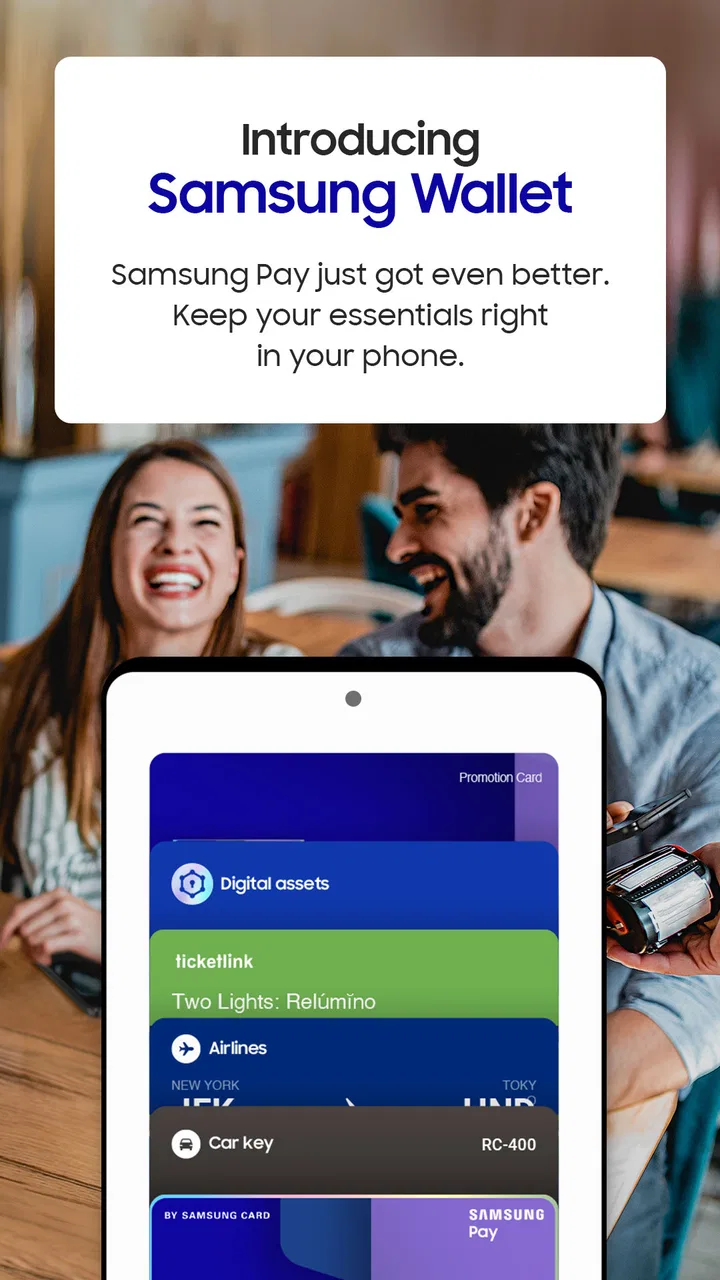
Samsung Wallet is Samsung’s mobile wallet for compatible Galaxy phones and smartwatches. It combines contactless payments with selected digital items, such as payment cards, loyalty cards, tickets, boarding passes, digital keys, and identification documents where supported. Its available features depend on your country, device model, bank, card issuer, and software version, so the experience may differ between users.
02Is Samsung Wallet safe for making payments?
Samsung Wallet uses security features such as tokenization, device authentication, encryption, and Samsung Knox protection to help safeguard payment information. Merchants generally receive a digital payment token rather than your actual card number. You can also require a fingerprint, face recognition, or PIN before authorizing transactions. Even so, you should keep your phone updated, use a strong screen lock, and report a lost device or suspicious activity immediately.
03Which banks, cards, and countries are supported by Samsung Wallet?
Support is not universal. Samsung Wallet availability varies by region and may include only certain Visa, Mastercard, American Express, debit, credit, or prepaid cards from participating banks. Some wallet features, including transit passes, digital keys, identity documents, and boarding passes, are also limited by location and partner agreements. Before downloading, check Samsung’s official compatibility list or try adding your card in the app.
04Can I use Samsung Wallet without an internet connection?
In many cases, Samsung Wallet can make contactless payments without a continuous internet connection because payment credentials are stored securely on the device and transactions are handled by the payment terminal. However, internet access may be required when adding or verifying a card, refreshing certain credentials, downloading passes, or using online wallet services. Availability can also depend on your bank, card network, phone, and transaction limits.
05What happens if my phone is lost, stolen, or replaced?
If your Galaxy phone is lost or stolen, use Samsung’s Find service or your Samsung account to lock or erase the device remotely whenever possible. You should also contact your bank or card issuer if you suspect unauthorized activity. Payment cards can generally be removed or suspended remotely, while replacing a phone may require signing in again and reactivating cards. Digital keys, tickets, and other passes may have separate recovery rules.
Pros
- Works smoothly with many Samsung Galaxy devices.
- Supports contactless payments
- loyalty cards
- tickets
- and digital keys.
- Samsung Knox adds strong security and tokenized payment protection.
- Can authenticate payments with fingerprint
- PIN
- or facial recognition.
- Useful integration with Samsung wearables and other Galaxy services.
Cons
- Limited availability and features vary by country and financial institution.
- Requires a compatible Samsung device and may not suit other Android users.
- Some banks or cards may not be supported.
- Certain features require NFC
- specific hardware
- or compatible merchants.
- Setup can be less convenient when switching between payment apps.

Samsung Wallet (Samsung Pay)
Gallery